


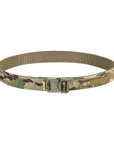
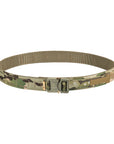
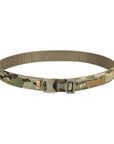

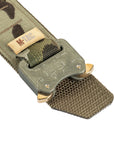
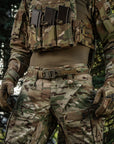
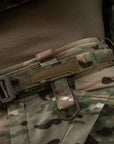
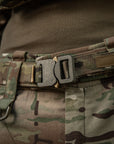


Cobra Buckle Tactical Belt Laser Cut
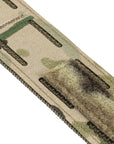
This military-tactical belt from M-Tac is designed to conveniently attach and carry equipment. The belt is perfect for military personnel, law enforcement officers and all connoisseurs of modern tactical equipment. This model allows you to place a holster, pouches for spare magazines, a first aid kit or other equipment compatible with the MOLLE interface. The belt is made of a strong nylon webbing (40 mm), the outside of which is lined with Cordura Squadron - a high-tech material resistant to abrasion and high loads. The MOLLE interface of the belt is made by Laser Cut technology and allows you to conveniently attach a pouch. The modern Cobra 25mm buckle from the Austrian manufacturer Austrialpin can withstand a load of up to 9kN (about 917 kg breaking load). Thanks to the well-thought-out design, a correctly adjusted belt will not fall or slip during active physical exertion or in combat conditions. The belt is available in sizes from XS/S to 3XL. Materials: Cordura Squadron Webbing: Murdock Buckle: Cobra 25mm from the Austrian manufacturer Austrialpin The AustriAlpin Cobra buckle is a high-strength, functional, very reliable buckle with the patented AustriAlpin COBRA ™ lock. Manufactured by AustriAlpin, an Austrian company specializing in the production of mountaineering equipment. The COBRA system lock is protected against unexpected opening under load and is used in high-quality mountaineering and military equipment. All buckles are Mil-Spec tested and certified for sand/dust/seawater exposure and pass CE, EN, CSA, ANSI, and NFPA standards. The unique design of the lock guarantees a high degree of reliability, safety, and durability. All COBRA buckles are made of high strength 7075-grade aluminum alloy. Components are made of solid brass and stainless steel. Camouflage "MULTICAM" was developed by the American company Crye Precision in collaboration with the U.S. Army Soldier Systems Center, commonly known as the U.S. Army Natick Labs. Creating the MULTICAM pattern took over eight years of expeditions, scientific research, data analysis, and practical field tests. It was designed to serve as a universal camouflage solution for the American army. The need for a new camouflage became evident after Operation Desert Storm in Iraq. At the time, the camouflage patterns in use, such as Woodland for forest terrain and Tri-Color Desert for desert operations, failed to provide adequate concealment for soldiers. Each operation still required specialized camouflage, complicating supply logistics and decreasing soldier safety. Even after introducing a new universal digital camouflage (Digital) during operations in Afghanistan and Iraq, the situation did not significantly improve. It became clear that a single universal pattern was necessary, one that would allow a soldier to blend into any terrain and at any distance from an observer. The goal was to create camouflage that worked equally well against various backgrounds, including vegetation, desert, rocky terrain, urban buildings, and ruins, under different lighting conditions and in any climate throughout the year. How does this camouflage work? It seemed almost impossible to achieve such a versatile pattern. However, the designers utilized the limitations of human vision and the structure of our eyes to their advantage. In theory, for camouflage to be effective at long distances, it should consist of large, blurred spots. At closer ranges, especially against backgrounds of foliage and vegetation where the human eye detects small objects more clearly, the pattern should incorporate small, rounded elements of the dominant background. The developers found that the predominant backgrounds across most regions of the globe share similar gradients of green and brown. An important revelation was that black, which is commonly used in camouflage patterns worldwide, does not actually appear in nature. By integrating their findings and conducting computer simulations that layered over a thousand images, the developers successfully created the MULTICAM pattern. Near Infrared (NIR) technology is utilized by the US Department of Defense to minimize detection by NIR electro-optical sensors. These sensors do not detect infrared radiation. NIR uniforms are made from a special fabric that helps soldiers maintain a temperature similar to that of the surrounding landscape, making them harder to spot. Additionally, NIR technology reduces light reflection, making the uniforms less visible in low-light conditions
DISPATCH
Estimated shipping times vary depending on your location and the shipping method you choose. Once your order has shipped, you will receive a shipping confirmation with tracking information so you can monitor the progress of your delivery.
We aim to process your order within 2-5 working days, unless otherwise stated.
DELIVERY
We offer different shipping options depending on your location and the speed at which you would like to receive your order. During checkout you can choose from available shipping methods (DHL/Post NL).
We accept returns within 14 days of the date of delivery. Returns received after this period may not be accepted.
Please note that items purchased during the last sale are not eligible for returns and refunds, except in the case of manufacturing defects or damaged products upon receipt.
High quality guaranteed
Not satisfied? Money back!
24/7 customer service